
If not for all the mobile phones, it would be like stepping back in time. The place 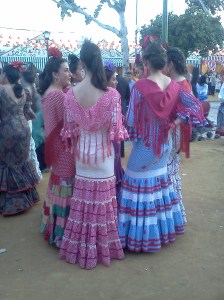 evokes a sense of the wild west, with dusty dirt roads, horses and ladies in beautiful dresses with full ruffles at the bottom. The women also wear huge painted flowers atop their heads and tasseled shawls which shimmy in time with their hips (which are hugged tightly by myriad colours and patterns, with polka dots as a strong favourite). Men mill about in suits and ties, while others ride horses in broad brimmed hats and grey vests. Whole families ride slowly along the streets in carriages, their horses decorated with bells and pompoms.
This is the Feria de Abril. Sevilla is a traditional city, and judging from my experience so far, they celebrate all the holidays with much flair and aplomb, upholding the same celebrations of their forefathers for centuries. For example, the Semana Santa (Holy Week) saw thousands of people crowded into plazas and streets to watch parades headed by Nazarenos (the eerily dressed worshippers who sport pointy hats, masks and robes, and generally remind foreigners of the Ku Klux Klan). The Nazarenos were followed 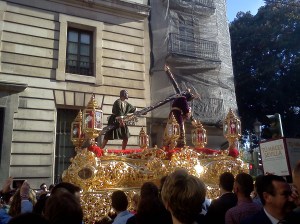 by huge floats, or pasos—carried on the shoulders of robust and devout young men—depicting figures of crying Mary and crucified Jesus, surrounded by candles, silver and gold lattice work and fresh roses. The feria, however, is not religious in nature, nor as old a tradition as Semana Santa. It began in the mid 1800s as a livestock fair, but quickly transformed into an excuse for a big party. Its purpose today seems to be dressing up in flamenco wear and heading out to a fair-ground to enjoy music, dancing, drinking, eating and general all-day, late-night, wee-hours Spanish merry-making.
Sevilla’s feria is lined with open-ended marquee tents, called casetas, which individuals rent for the use of their family, friends and friends of friends, where they can enjoy their own personal feria party alongside hundreds of other individual celebrations. The casetas are equipped with tables, dance floor, bar and kitchen (I am not sure if they hire their own kitchen staff or if that comes with the rental of the caseta). There are also a few larger tents open to the public, one to represent each neighbourhood of Sevilla. However, these tents are “not as good” as the private ones, according to Sevillanos, and some consider it not worth going if you have no invitation into someone’s personal caseta. Having been warned of this, I was not sure what to expect going to the feria. I was happy to discover a scene that felt like an enormous game of dress-up, and even had I not known someone (who knew someone who knew someone) with a caseta, it would have been well worth it to walk the dirt roads, admire the beautiful dresses, watch the carriages pass and listen to the horses clip-clop by.
As it turned out, we were fortunately invited into a few casetas thanks to friends from school and language exchanges, and we celebrated by staying out until 2am or so—a moderate departure time by Spanish standards (the brightly lit streets were still pulsing with music and festivities when we left). 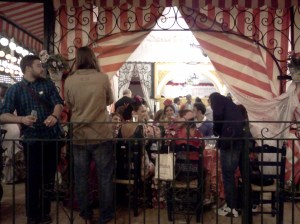
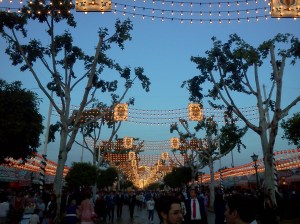
The feria runs for a week straight and children get two days off school in its honour. Many people attend the grounds every afternoon or evening, and stay until late. Sevillanos are not the only ones who take the Feria de Abril very seriously, and many people from out of town also come to rent their own casetas and partake in the city’s famous celebration. Not that their own hometowns would not have a version of the feria, but the festivals of other towns and cities are not as big and traditional as that of Sevilla (for example, in some towns the women only dress up on one day instead of all week long—not nearly enough fun). There is also a large area with rides and attractions beside the rows of casetas if you want a break from eating and drinking in exchange for a spike in adrenaline or some carnival games.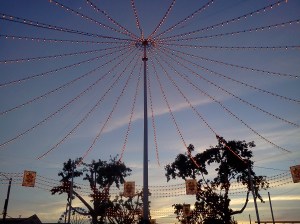
The more time I spend in Spain, the greater the sense I have that these people really know how to celebrate. They love food, drink, dancing, music and good company, and that love results in true feasts of the senses, such as that of the Feria de Abril de Sevilla.
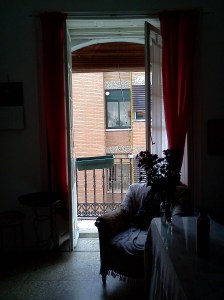 I have unpacked everything, found places for things, hung our Sunshine Coast calendar on the wall, and begun to settle in and stretch out like a cat in its favourite box. There is a desk to write at, space to practice yoga, and two balconies with wrought iron railings to lean out over and watch the scurrying day unravel below. We can reach the Spanish school in a five minute walk, the river flows wide and deep a block or so away, and this old apartment—with high ceilings, a quirky mix of furniture, sloping floors—is large enough to give private lessons or small group classes in English and yoga. The plan for finding work is developing. We have ventured deeper into the country, seen the coast, explored another city. We have made a few friends, both Spanish and foreign. The days grow longer and the sun shines hot in the afternoons and the breeze rocks the open windows gently back and forth. Things are coming together.
 cracking the tops of crème brulée and things like that—not that I have had any crème brulée, but I have enjoyed other sensual food moments like slicing up strawberries and bananas and eating them with honey, or cooking myself a mushroom risotto with a glass of a wine and music. Moments like those make me feel independent and chic, but also a bit like a kid who has finally been deemed old enough to be left home alone. Either way, a bit of solo dancing round the kitchen lends itself to making the most of a night by yourself.
 Tegan Bethune